• Home
  • About
  • Contact
  • Advisory Board
  • DIsclaimer + Disclosure
  • 
  • 
  • 
  • 

Happy Healthy Kids

News and tips for helping kids grow strong, stay well, and feel good.

  • FOOD
  • FITNESS
  • FUN
  • WELLNESS
  • MENTAL HEALTH
  • JUST FOR YOU

5 Strategies for a Healthy Halloween

October 28, 2015 by Kelley Leave a Comment

strategies for a healthy halloweenLest you assume from this post title that I’m going as Debbie Downer this Halloween, rest assured, I’m all for sweets and excitement on Saturday night. Some of my most cherished childhood memories involve running through the dark, gown or tail trailing perilously through the leaves, collecting enough Reese’s Peanut Butter cups to last me through Easter. But years of writing health columns and scouring E.R. data for various publications have taught me that the spookiest night of the year can pose some pretty real health challenges that can’t be fixed by just some extra tooth-brushing. Here, five quick tips to keep in mind as the sun goes down on Halloween 2016.

Teach kids to stick to lawns and sidewalks, not streets, when trick-or-treating. The scary truth: Halloween is ranked as the No. 1 day of the year for child-pedestrian accidents and fatalities. The majority of these fatalities occur during the peak trick-or-treating hours: 5 pm and 9 pm, with the deadliest hour of all being from 6 pm to 7 pm. The stimulus and crowds make it hard for drivers—think excited teenagers, or parents rushing home from work to join their kids—to navigate. So push these simple rules: Stick to lawns or sidewalks on one side of the street while trick-or-treating. Cross carefully, and only when necessary. Children under 12 should stick closely to parents, and older kids should travel with a large group of children.

Make sure trick-or-treaters know your cell phone number, or have it written on their hand or on a visible place on their costumes. My youngest son’s favorite book right now is Angelina’s Halloween, but for me, it’s terrifying: In it, little Polly mouse gets lost in the trick-or-treat shuffle, only to be found by her big sister on a doorstep hours later. Eek. Fact is, even experienced caregivers can lose sight of their ghosts and goblins. Make sure your child wears reflective tape or a glow stick necklace (grab 25 for just $10 on Amazon) in a color you’ve noted and identified, and teach or label them with your cell phone number before you set out for the night. If your older child is heading out with friends, pack a cell phone in their treat bag, and keep track of his or her whereabouts with a handy family-member locator app.

Keep sensitive kids shielded from too-scary imagery. While scary movies, haunted houses and the like may seem in the spirit of the season, be cognizant of how they might trigger your child’s fears. NYU researchers have that little kids who watch violent movies, including Halloween horror films, television shows or video games, may be more likely to develop anxiety, sleep disorders, and aggressive and self-endangering behaviors.

Monitor your child eating his or her candy. Of course, you’ll want to confiscate a few of your own faves as a price for your chaperoning efforts, but there are other reasons for hanging out while your child sorts through his plunder. Thankfully, razor blades and poisonous chemicals planted in candy are an overblown threat to kids, but allergens aren’t. Even if your child hasn’t been diagnosed with an allergy, he or she can develop one at anytime—especially young childhood—and many candy bars contain the most common and dangerous allergen: nuts. If there are any signs of rash, oral or throat itchiness, trouble breathing, or a bellyache that can’t be explained by a few too many Hershey’s miniatures, contact a healthcare provider immediately (or 911 for respiratory distress), and administer a dose of Benadryl while you monitor the situation. (If your child has a diagnosed food allergy, look for houses with teal-colored pumpkins—parents there have pledged to dole out only non-food treats.) Also, make sure children under 3 don’t get into treats like Gobstoppers, gumballs, or stiff taffy, all of which are choking hazards.

Make a dinner and bedtime plan. This year’s Halloween presents a perfect storm of routine-wrecking possibilities. Not only is the holiday on a Saturday night, theoretically giving kids more freedom to stay out late, the next morning we turn the clocks back, giving everyone (save for the millions of us with small children who wake up with the sun) an extra hour of sleep. But as tempting as it is to allow children to trick-or-treat well past their bedtime—the childhood equivalent of a late-night bender—experts advise against it. In his child sleep blog, Dr. Craig Canapari recommends allowing kids to stay up just a half-hour later than their usual bedtime in the three nights before DST ends (that includes Halloween), and then switching back to the “regular” schedule on November 1. As for dinner: set aside a time for kids to have a real, filling meal so they don’t load up later on candy: There is a real uptick in hospital visits for abdominal pain and diarrhea related to candy consumed on Halloween.

Be safe and enjoy!

Share

Do Boys Need a Violent Media Detox?

October 27, 2015 by Kelley Leave a Comment

violent media detoxAbout six years ago, I attended a local mother’s group lecture about media violence and its impact on kids. The speaker was Nancy Carlsson-Paige, a professor of early childhood education at Lesley University (and, in an interesting side note, Matt Damon’s mom). She didn’t talk about her famous son; she talked about the worrisome pervasiveness of fighting and weapons in kids’ entertainment. As she talked about the need to steer our children toward peaceful images and messages, I nodded along with the rest of the parents in the audience. It made perfect sense, and I vowed, at least that night, to be more careful about what my boys, then two in number and still in the tot stage, watched.

Fast forward to this moment: My third son, nearly 4, is a few feet away, waging an imaginary war with Deceptions. This is something he does for a disturbingly large portion of his waking hours. A healthy interest in trucks and trains and furry animals has given way to a fascination for robots, and not just any robots—huge, weaponized ones with names like Megatron, Demolisher, and Snarl. And how can I blame him? I let him watch Rescue Bots for his before-dinner show. I indulge his interest by printing out images of the metal beasts and pasting them into a “Transformers” book we created together. Hell, one rainy day last week, I played Ratchet to his Shockwave in a game of indoor tag, gruff, angry voice and all.

Even as this interest made me a little uneasy, I pushed worries away, assured by the fact that almost every boy I know is into some show or game involving some sort of weaponry, be it a ninja sword or “ice breath” or metal fists. Isn’t that just what boys are into? When my oldest son was a toddler and I wondered aloud about toy guns, a veteran mom friend assured me that if I withheld them, “they’ll just make one out of sticks anyway.”

(Then there’s this honest fact: When he watches or plays with Transformers, my youngest son is busy. And happy. And for a busy mom of three, that’s worth its wait in gold.)

But something last weekend brought me back to that moms’ group lecture. My mother-in-law, a longtime teacher and world-class mom and grandma, was visiting. After gamely reading Buddy Brawl aloud to my son for about the 13th time in an afternoon, she looked at his pile of Transformers’ books and mused lightly, “I wonder how storylines like these change a child’s worldview?” It wasn’t a judgment, but an honest question; and, as I thought about it over the course of the next day or two, an excellent one.

I did a little research, and discovered that the effect of violent programming, even seemingly innocuous cartoons involving fighting, has a negative impact, on boys, particularly. An especially persuasive 2007 University of Washington study in the journal Pediatrics found that for every hour a day spent watching violent TV as a preschooler (I’m talking Power Rangers-level stuff, here), boys were three times more likely to exhibit behavior problems at age 7. And in studies performed at Princeton, researchers discovered that kids who watched a heavy amount of fantasy violence had lower-level moral reasoning skills than their peers.

So, I’m embarking on an experiment: To remove from the DVR, iPad, and desktop “favorites” bar any show or game involving fighting or weapons, for a month. While the impact of books is less clear, for the sake of continuity, I’m tucking away the Transformers, Star Wars, and Superhero books for a time as well. (I won’t worry about stuff they do at friend’s houses…who wants to be “that mom?” And anyway, my goal is to reduce exposure, not eradicate it, which would be impractical.) When the same University of Washington researchers, above, prescribed to preschoolers a similar “media diet” of prosocial programming only, their behavior noticeably improved. I’m curious to see whether it cuts down on the kids’s level of play fighting and real fighting—which, while not overtly aggressive or dangerous, has been picking up lately. If the kids balk, I’ll explain it isn’t a punishment, but an effort to explore some new shows they might love. To my older sons, I’ll also speak honestly about my concerns about the impact on-screen fighting has had on their baby brother (whose pugnacious style of play, apparent with his brothers if not his peers quite yet, can often be as annoying to them as it is concerning to me.)

It won’t be easy: The older boys will have to forego their favorite iPad app (involving warring clans) and the little guy is bound to have some Autobot withdrawal. I’m going to have to log some serious time reconfiguring TV and computer settings. But if they pick up just a few more positive media options (and possibly brain cells) along the way, I figure it will have been worth it. In the next week or so, I will report back about the non-violent, boy-friendly shows and apps that have gotten the household thumbs-up.

I’m not expecting miracles, here. Just a little more peace in programming (and, hopefully, the playroom). Wish me luck.

Photo credit: The Team via Photo Pin, cc

Share

Forget Self-Esteem; Kids Need Self-Compassion

October 22, 2015 by Kelley 1 Comment

teaching a child self-compassionWe parents get a lot of messages about the importance of teaching our children confidence (in themselves) as well as kindness (to others). But a growing number of psychologists are saying that we should pay more attention to merging the two, encouraging kids to be kinder to themselves. The payoff: greater well-being and less fear of failure.

“Self-compassion is learning to extend understanding, compassion and encouragement to yourself when things don’t go your way, treating yourself the way you would a close and treasured friend,” writes psychologist Shilagh Migrain, Ph.D., in the “Growing Up Healthy” blog she writes at the University of Wisconsin. “Research shows increasing self-compassion has all the benefits of self-esteem but without the downsides. Unlike self-esteem, self-compassion reduces anxiety, lowers feelings of embarrassment when you mess up, and is associated with steadier and more consistent feelings of self-worth.”

The difference is subtle, but important. I think of it this way: Let’s say a kid messes up a drawing, is left off the birthday party list, or gets shelled in the hockey goal. The child who’s told time and again that he’s terrific might, ironically, struggle to accept and overcome such blows to his pumped-up identity. The child who’s instead taught self-compassion may be more inclined to think, “This didn’t work out the way I wanted it to, and I’m bummed about it. But I’m still here—and I’m okay.”

It’s such a simple concept—not to mention a core principle of Buddhism—but not one I’ve ever thought much about before when it comes to parenting. It also seems so very important now, since, thanks to social media and an increasing hyper-competitive school and sports culture, kids are being scrutinized in all the wrong ways. Success (and screw-ups) feel more high-profile and high-stakes than ever. Encouraging kids to be their own friend—not the vapid cheerleader one, but the one who always, gently but lovingly, tells you the truth—might be just thing to keep them steady when they feel overwhelmed or lonely. Far from encouraging a personal pity party—my knee-jerk suspicion when I first came across the idea of self-compassion—it may actually help kids become more resilient, according to University of Austin professor Karen Neff, Ph.D., one of the first psychologists to write about this topic in the realm of child development.

But how to take an idea that sounds, admittedly, sort of trite and make it practical? Other than modeling self-compassion ourselves—i.e., biting our tongue when we’d like to belittle our work, our bodies, or the pot roast we’d cooked for dinner—many psychologists advocate teaching kids to physically self-soothe. For little kids, you can show them how to (literally) give themselves a hug. They can wrap their arms around themselves for a few moments, taking some deep calming breaths. As for bigger kids, suggest they simply place one hand over their heart in times of stress. Ask them to see if this small, subtle touch helps them feel calmer, more connected.

Share

Make-Your-Own Apple Rings

October 8, 2015 by Kelley Leave a Comment

When my oldest son was an only and I still had the time, energy, and inclination to do daily, enriching projects with him (sorry, little sibs), we made a “fruit chart,” with his faves at the top and the ones he disliked at the bottom. Number one was strawberries (still is). Last: blueberries (all it takes is one shriveled, sour one to turn a kid off forever.)

Last week, the U.S. Department of Health unveiled a much more scientific poll evaluating the fruits most commonly consumed by American kids, and the winner, by a landslide: the humble apple. Turns out, one-fifth of children eat an apple a day. Which is great news: They’re full of fiber, a good source of vitamin c, and only about 90 calories.

Kids' Daily Fruit Intake
Apples (20%)
Fruit Juice (10%)
Melons (6%)
Other Fruit/Fruit Salad (5%)
Data from the National Health and Nutrition Examination Survey, 2011-2012

Apples are big in our house too, especially this time of year, when they are plentiful, cheap and at their apple rings 3peak of crunchy, sweet deliciousness. As millions of U.S. children apparently know, an apple is terrific as is, but I recently came across a pretty fun snack that makes them more “treat-like.” A little like the Make-Your-Own Trail Mix I wrote about a while back, the genius of this snack is that it lets kids in on the prep process, allowing them to customize their own apple rings as they would a pizza or cookies. I don’t know about your kids, but in our house, agency=greater acceptance when it comes to new foods.

Print
Make-Your-Own Apple Rings

Make-Your-Own Apple Rings

Ingredients

  • 2-3 large, round apples
  • A variety of toppings (here are some ideas):
  • -1-2 kinds of nut or seed butter (peanut, almond, or Nutella)
  • -Cream cheese
  • -Peanuts
  • -Sunflower seeds
  • -Chocolate chips
  • -Raisins or Craisins
  • -Mini marshmallows
  • -Shredded coconut
  • -Crumbled pretzels or chopped pretzel sticks

Instructions

  1. Core and thinly slice apples width-wise to make 1/4 wide rings.
  2. Serve the rest of toppings in small bowls and let kids decorate their own rings. Have them start by spreading each ring with a nut or seed butter or cream cheese to help the rest of the toppings stick.
3.1
https://www.happyhealthykids.com/make-your-own-apple-rings/

Share

To Help or Not to Help (with Homework)

August 28, 2015 by Kelley 2 Comments

should parents help with homeworkA recent study in the journal Psychological Science has given us yet another example of how parental help can backfire, and it’s an eye-opener: Apparently, when parents who lack confidence in math try to lend a hand with their first- and second-graders math homework, their children perform worse than if they didn’t get any homework help at all. In fact, the more these math-anxious parents “helped,” the worse off kids were, falling behind as far as a third of a grade level in math.

I feel for these homework meddlers, and given the over-involved ways of our parental generation at large, I suspect I’m not alone. While I’m opposed to the idea of doing kids’ homework with them, I buzz constantly around my oldest son’s workspace in an effort to help “keep him on track.” And yet, the battle over getting homework done, and well, has produced more bickering and tears than pretty much any household issue we’ve faced together in the past year. So much for “helping.”homework help

This year has to be better, not just in terms of the quality of homework turned in, but also the after school rapport between my son and me. So, on the verge of this new year, I turned to teachers I know and respect for guidance. I assembled a short, informal homework survey, and more than two dozen of these teachers and their colleagues kindly participated. The data shows some real trends of thought, which I’ll share here.

Teachers do want us to be around at homework time…
I asked the teachers, “What approach should parents ideally take to homework?” Fully 22 out of 25 teachers agreed that it’s best to “be available—give them space and expectations, and also ensure that one adult is in the vicinity to field questions and provide direction.” A couple supported the idea of a complete “team effort,” but surprisingly, not a single one agreed with the idea that we should “leave kids alone—it’s important that they take initiative and demonstrate their knowledge to teachers independently.”

…But we need to keep our hands off the work. 
The biggest mistake we make at homework time? According to the majority of teachers surveyed, it’s “doing kids’ work for them.” But the second most common teacher peeve is at the opposite end of the involvement spectrum: when we “don’t provide them with enough structure or space to do the work to the best of their ability.” Clearly, the best approach is a middle-of-the-road one, in which we don’t do too much or too little, but set them up for success. One teacher put it this way: “Both hovering and doing their work for them are detrimental. Students need to be able to do their work on their own, but with help when needed. With today’s standards, much of the curriculum is taught in ways that parents didn’t learn, making it hard for them to help their students.” (Cue to the math anxiety study, cited above.) Here’s a humbling thought: our kids might understand the material better than we do.

The kitchen table might be the worst place for your kids to be doing their homework.
When I asked where kids should be doing their homework, I figured most teachers would recommend “at a desk, preferably in their room.” But only a handful of those surveyed agreed with this statement. Even fewer prescribed “the kitchen table or some other central location.” Instead, the majority—65%—thought that kids should do their homework “anywhere they are comfortable,” with many stipulating that it should be in a quiet space, with a parent in summoning distance. Maybe time for a lap desk?

Routine, routine, routine.
Many teachers commented that the most important key to diffusing homework battles is establishing a regular time and place for getting it done. “Do it first thing after school, and have all your kids do it at the same time,” said one teacher. But another voiced why this might be tricky for so many of us: “So many other commitments make it hard to develop a routine.”
Perhaps the answer, for many of us busy families, is making a homework schedule—say, on Sunday evening—that takes into account the different activities happening throughout the week. And then, perhaps posting it somewhere central—and hardest of all, enforcing it. For me, this brings home the idea that in order to get my kids into a homework routine, I have to develop one, too. My habit of announcing, suddenly, that “it’s time to get homework done!”—perhaps in the car, because we happen to be 10 minutes early to soccer practice, and tossing a pencil from my purse backwards in my son’s general vicinity—feels a little like a code blue for everyone. Not really the best milieu for quiet contemplation of concepts learned earlier in the day.

My takeaway from these incredibly helpful teachers is that to best facilitate homework success, we parents need to think of ourselves less as the talent, and more of the advance man. We are here to set a schedule, set the stage, and then step back into the wings. And maybe—just maybe—develop a bit more sensitivity when our children fall to weeping at the idea that there’s a back to sixth spelling worksheet of the night. “Kids tend to take out their negative feelings about homework on their parents as they really can’t do that to their teachers,” said one respondent. “They often feel homework is redundant. Teachers and schools should make a real and ongoing attempt to be sure homework is relevant practice of learned concepts, and not excessive.”

Okay, so routine, space, communication, and compassion: That’s my four-part plan for making homework less dreadful for everyone this fall. What’s yours?


Share

Ultimate Summer Salad

July 31, 2015 by Kelley Leave a Comment


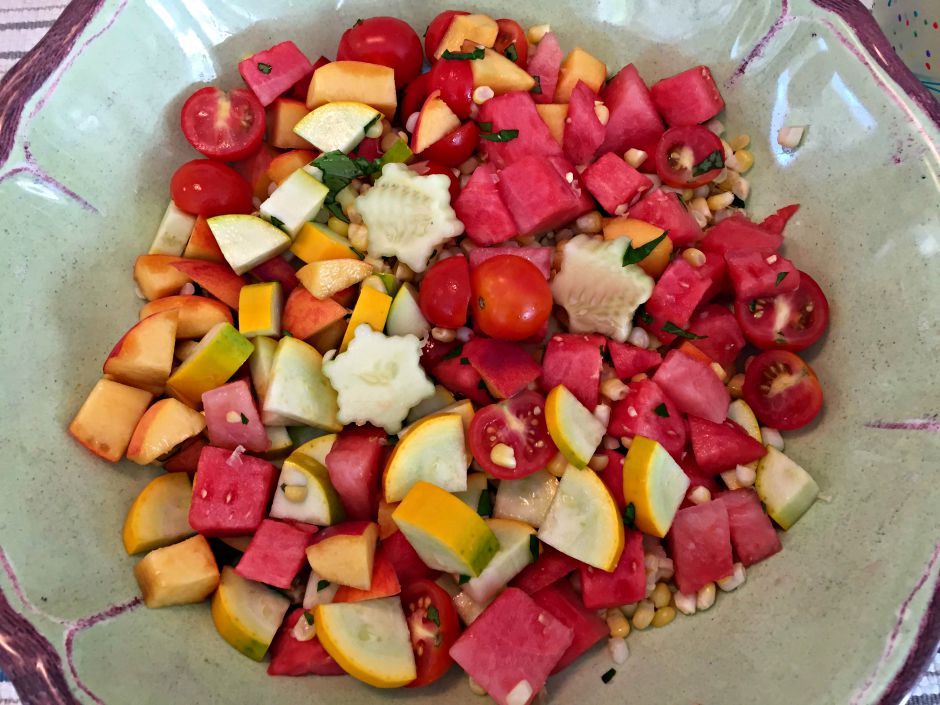
ultimate summer salad 2It’s late July, which means in the Northeast, at least, summer produce is peaking—to the point, in some cases, of total garden domination. We gardeners—and anyone who regularly hits a farmer’s market or

Our overflowing late-summer garden.

Our overflowing late-summer garden.

even just a well-stocked supermarket—are faced with bumper crops of just-ripe (or low-priced) corn, zucchini, cucumbers, tomatoes, peaches, and more. Too often, we pick or purchase perfect produce with high hopes, only to be digging a spongy specimen out of the crisper too weeks later.

boys at volantes 2015

The boys at our favorite local market, Volante Farms.

Rather than try to selectively use all this great produce one at a time, I’ve lately been making a big salad that showcases several at once. This approach is nicely family-friendly, kids can pick around the one or two things they don’t like, and seem to be more inclined to try something new when it’s cozied up to a fruit or veggie they’re used to. You can also mix and match to highlight whatever is growing or on sale. The one constant: watermelon, which all kids seem to love and has a mild taste that pairs well pretty much any summer veggie.

By not dousing it with heavy dressing—just a squeeze of citrus and a splash of good olive oil—this salad lasts for at least a few days in the ‘fridge. It’s great on its own or mixed with some protein—quinoa, edamame, cheese, pine nuts for lunch, or shredded rotisserie chicken, salmon, or shrimp for dinner.

Print
Ultimate Summer Salad

Ultimate Summer Salad

Ingredients

  • 1-2 cups diced watermelon
  • 1 cup tomato chunks (about five halved cherry or 1-2 seeded and chunked standard tomatoes)
  • 1 cup fresh corn kernels (shuck and boil 1-2 ears for 4 minutes; cool and slice kernels off)
  • 1 cup cucumber pieces (about 1 large cucumber; make half moon shapes or use these great flower shaped cutters
  • 1 cup yellow or green zucchini chunks
  • 1 cup diced fresh peach (about 2 small peaches)
  • 1/4 cup basil or mint, minced
  • 2 tablespoons extra virgin olive oil
  • 1/4 teaspoon salt (to taste)
  • 1/8 teaspoon pepper (optional, to taste)
  • One small lemon or lime, or 1/8 cup rice wine vinegar

Instructions

  1. Place veggies in large bowl. Drizzle with oil and sprinkle with herbs and salt (and pepper if desired). Place fruit chunks on top, and squeeze lemon or vinegar to taste. Mix well and serve at room temperature. Refrigerate leftovers.
  2. KIDS LUNCH: Serve with ham roll ups, cheese sticks, or mini sandwiches on the side
  3. GROWN-UP LUNCH: Mix in any or all: 1 cup cooked quinoa, 1/4 cup pine nuts, 1/4 cup shelled, edamame, 1/4 cup feta, 1/4 cup diced mozzarella
  4. FOR DINNER: Mix in or add to the side: shredded rotisserie chicken, poached salmon, grilled shrimp
3.1
https://www.happyhealthykids.com/ultimate-summer-salad/

Share

Neighborhood Games Kids Should Know

July 26, 2015 by Kelley 1 Comment

neighborhood gamesAs kids age, telling them to “go play”—the refrain of summer—gets trickier. Lately, I’ve been longing for the days when my older boys happily played with a jumble of toys or on our swing set for hours on playdates. Now, when my 9- and 7-year-old sons have friends over to our house, they play some sports, sometimes skirmish with Nerf or water guns, and ask, disappointingly often, to use the computer or iPad. We’ve resisted buying an Xbox—for better or worse, depending on how you look at it.

On summer days in my childhood, neighborhood kids would play together for hours, no digital or sports gear needed. We played games—various forms of tag, Red Rover, Kick the Can, and when the fireflies emerged, Manhunt or Ghost in the Graveyard. So when my older sons had two equally active, adventurous friends over this afternoon, I got two sticks, tied bandanas to them, and suggested Capture the Flag. They played for nearly two hours, swapping alliances for various rounds—and I haven’t heard such delighted shrieks—or seen such sweaty faces—from a group of kids in a long time.

It occurred to me that my kids don’t know how to play most of the neighborhood games that dominated my childhood. So, as we close out a camp-packed July and enter a less structured August, I’m making a cheat sheet of games for my children and their friends (you can select and print the 8 x 10 sheet below). Feel free to adapt the finer points; you may have used different rules and names than we suburban Philly kids did in the 80s. And if, on a summer’s evening, you want to jump into a round of Manhunt, expect to score some major points with the kids.

neighborhood games instructions


Share

Does Birth Order Matter (Really)?

July 21, 2015 by Kelley Leave a Comment

does birth order matterAdmit it: You’ve bought into the idea, at one time or another, that birth order really matters. It’s fascinating to consider the idea that the reason your children’s personalities are so different has to do with where they’re positioned in the nuclear family tree. And the stereotypes, so often on-point anecdotally, can be convenient. Your oldest is so (studious, responsible) because that’s the way firstborns just are. Your baby will always be (vivacious, goofy) because she’s, well, the baby. As for your middles—forget it. They may be making their own pancakes by age 2, but their (feelings of isolation, neglect) might cause them to fly the coop and never look back at age 22.

But a big new study deflates some of the most common beliefs about the effects of birth order on children. Researchers from the University of Illinois at Urbana-Champaign studied 377,000 American high school students, a massive sample size relative to other birth order studies to date. The study was controlled for such potential confounders as family’s economic status and number of children. The team found:

-Firstborns do have a higher IQ than later-borns, but by just a single point—a statistically significant but, according to researchers, meaningless difference. The strongest association in terms of cognitive trends was for higher verbal ability in firstborns, but the correlation—of just .08—was still too small to matter much.

-Being born first was also associated with being slightly more extroverted, agreeable, and conscientious, as well as (surprisingly) less anxious, according to their data. But these personality correlations are, like IQ, too tiny to matter in real life. “You are not going to be able to see it with the naked eye,” one researcher explained. “You’re not going to be able to sit two people down next to each other and see the differences between them. It’s not noticeable by anybody.”

The researchers’ takeaway? “The message of this study is that birth order probably should not influence your parenting, because it’s not meaningfully related to your kid’s personality or IQ,” the study’s lead author, Rodica Damian, Ph.D., said. In other words, we shouldn’t expect—or explain away—certain behaviors due to our kids’ position in the family. This provides some helpful perspective for me, as the mom of three boys with very different abilities and personalities. There have been times when I’ve attributed one kid’s strengths or weaknesses to birth order; and other times when I’ve wondered why my oldest isn’t more detail-oriented, or my youngest isn’t “easier” (i.e., living up to the more positive birth-order stereotypes). Fact is, they’re all delightfully complex—and life is, on all but the craziest days, all the more interesting because of it.

Photo credit: J.K. Califf via Photo Pin, license cc

Share

5 Common Summer Ailments in Kids

July 16, 2015 by Kelley Leave a Comment

common summer ailments in kidsMost of us associate sick days with wintertime. That’s when storefronts and commercials are dominated by cough syrup and Kleenex; not now, when sunscreen and beach balls take center stage. So when our kids spike a fever or complain of a sore throat on vacation, it may take us a bit longer to catch on—and, frankly, accept—that they’re under the weather.

As much of a drag as summer ailments are, it’s important they’re on every parents’ radar. Some health problems that go along with warm weather are as, if not more, serious to kids’ health than the coughs, colds, and flu that circulate during the school year. To get the scoop on what pediatricians are seeing in the office right now, I talked to my friend Laura Scharf, M.D., a pediatrician at Quincy (Ma.) Pediatric Associates who also serves as a physician at Camp Becket in the Berkshires, as well as HHK’s advisors Naline Lai, M.D. and Julie Kardos, M.D. of Two Peds in a Pod. Here, they weigh in on how to recognize and treat some of kids’ most common summer ailments. (In each case, be sure to consult with your child’s own healthcare provider for individualized treatment.)

Coxsackie (Hand, Foot, and Mouth Disease)
Common in kids, Coxsackie often spreads around pools, sprinkler parks, public bathrooms, and other “wet” places. Part of the large family of enteroviruses that live in our gut, different Coxsackie strains cause different symptoms, but hallmarks are a high fever and small, sometimes painful blisters around the mouth, hands, feet, and sometimes buttocks. “A new strain we’re seeing can also cause a more extensive rash, often on the lower legs,” says Dr. Scharf. Kids can also get runny noses and pinkeye.
How to treat: Ibuprofen or acetaminophen (administered as directed on the label) can control fever and pain. Soft, cool foods and drinks like yogurt and milkshakes can help soothe blisters in the mouth and throat. Symptoms usually go away in 3-7 days.

Summer Colds
Believe it or not, we’re seeing a lot of colds in the office, says Dr. Lai. Often caused by different enterovirus strains than the ones that cause Coxsackie, these colds may bring on a fever and cough. They circulate where a lot of kids congregate, like camps and daycare. “So it’s not surprising we saw a spike after the July 4th holiday,” Dr. Lai says.
Prevent and treat: Viral colds can’t be eradicated with an antibiotic. Rest and lots of fluids is the best prescription. Your child should feel better within a week; if not, see a doc.

Lyme Disease
Prevalent in the northeast, Pacific northwest, and midwest, particularly in woodsy areas (but not always), Lyme disease is the most common illness spread by infected ticks. (Other tick-borne illnesses include babesiosis, ehrlichiosis, and Rocky Mountain Spotted Fever. For a complete rundown, with geographic trends, check out the CDC’s page, here.) Kids who end up testing positive for Lyme come to the doctor’s office with a nagging fever, aches and pains, and sometimes a bulls-eye-shaped rash. Read more about diagnosing and treating Lyme in this previous HHK post I did with Lyme expert Nevena Zubcevik, D.O.).
Prevent and treat: Apply sprays with 20% picaridin or 30% DEET on your child before he or she goes outside for long periods, especially around wooded or grassy areas. See a doctor right away if he or she has a strange, circular rash or unexplained, recurring fevers or achiness (without other symptoms). Lyme can be diagnosed through blood tests (though false negatives are common, so be sure to follow up if symptoms persist), and treated successfully with antibiotics, especially if caught early.

Rashes
“Summer is rash season,” says Dr. Scharf. Some skin flare-ups are associated with illnesses, such as Coxsackie or Lyme, above. But our peds are also seeing a lot of bumps and welts due to photosensitivity (a reaction to excessive sunlight), contact dermatitis (sensitivity to a material or a product, often a new sunscreen), heat rash (when sweat gets trapped under clogged pores), poison ivy, and bug bites.
Prevent and treat: Limit sun exposure, especially if you have a  sun-sensitive kid, and do a patch test to make sure a new sunscreen or product agrees with your child before sending him or her out for the day (sensitive kids often do best with mineral-based sunscreens with titanium dioxide or zinc oxide.) Teach your kids to avoid overgrown wooded areas and keep to paths to avoid poisinous plants. Dressing your child in loose, lightweight clothes can help ward off heat rash. If rashes develop, consult your pediatrician or dermatologist; treatments range from calamine lotion to topical steroids in more extreme cases, to temper welts and stave off itching. It’s important to keep sores clean with soap and water, and to teach kids try to avoid scratching too much, especially with unclean hands. “We see a lot of infected bug bites from this, “says Dr. Lai.

Stomach Bugs
Foodborne illnesses peak in summer months. Bacteria on food grows fastest in warm, moist conditions, and people are often cooking and eating far away from refrigerators and trusted heat sources that can regulate storage and cooking temperatures (think of picnics and beach barbecues). Illnesses usually strike within minutes or hours of eating a contaminated food, and can be mild or severe, causing abdominal pain, diarrhea, vomiting, and sometimes fever. Kids can also pick up bugs from swimming in—and often swallowing—contaminated water. Between 1978 and 2010, norovirus was the second-leading cause of illness outbreaks associated with untreated recreational water, such as lakes, according to the CDC.
Prevent and treat: Clean hands frequently when preparing food, and be sure to keep food that’s susceptible to bacteria (like raw meats) packaged tightly and separated from other edibles. Keep raw produce and meats cold with frequently changed ice packs if outdoors, and cook foods to recommended temperatures (145 for beef steaks, 160 for ground meats, and 165 for pork). The USDA recommends bringing a meat thermometer to picnics and cookouts. If a queasy stomach strikes, keep a child hydrated with plenty of non-acidic, non-dairy fluids. When kids are swimming, especially in untreated lakes or ponds, make sure they avoid swallowing water, and wash up afterwards.You can also replenish them gradually with small sips of oral rehydration solutions made with electrolytes.

Photo credit: Dave Jacquin via Flickr, cc license 2.0

Share

Help for When a Pet Passes Away

July 2, 2015 by Kelley Leave a Comment

help for when a pet passes awaySkype is dying.

I don’t mean the video communication technology—though that may very well be on its way out, too—but my 7-year-old son’s betta fish, who’s lived in a plastic bowl on his nightstand for three years. (Why he decided to name him after said technology remains a mystery I haven’t bothered to probe.) Once a vibrant, puckish swimmer and ravenous eater, Skype has been laying listlessly among his plastic plant fronds and refusing food for the past week. Once a brilliant sea green, his scales are now a dull, sad brown.

On the spectrum of loss, I realize that losing a pet fish might seem insignificant, but not to my little guy. This son, who resembles a golden retriever in look and behavior himself, loves animals—all kinds—and will spend days tending to slimy snails he found in the pond near our house. I’ve resisted getting him a furry pet until he and his brothers are older, so Skype is and has been the recipient of all the attention and affection that can possibly be bestowed on a two-inch long, cold blooded creature whose species nickname is “Siamese Fighting Fish.”

For the past several mornings, my son has checked on Skype as soon as he woke up. “He’s still alive!” he’ll say triumphantly. But I know the morning is coming very soon when he will pad down to the kitchen, his big eyes (sea-green like Skype’s) welling with tears.

City Dog, Country Frog

City Dog, Country Frog by Mo Willems and Jon Muth.

There’s been one big comfort to him through all this, and it’s not the promise of a replacement fish or something bigger and cuddlier when the time comes. It’s two books I found at the library. We’ve been reading them all week.

The first is City Dog, Country Frog, a joint project by two of favorite children’s author-illustrators, Mo Willems and Jon Muth. Compared to many of Willems’ and Muth’s other works (like the Pigeon series, or Zen Shorts series), this book isn’t exactly a hold-shelf shelf staple, probably because it deals with dying. But it does so gently, and hopefully. Set against the backdrop of the changing seasons, it explores a friendship between an energetic puppy and a wise frog. The animals play together in the spring and rest in the fall (frog is tired). In the winter, the dog has to confront the idea of loss when frog is nowhere to be found. But when spring comes ’round again, so does a new frog friend, and the circle of life and friendship continues.

Sally Goes to Heaven, by Stephen Huneck.

Sally Goes to Heaven by Stephen Huneck

The second is Sally Goes to Heaven. Unlike City Dog, Country Frog, it dances not at all around the idea of death. And yet I can’t imagine a book that could provide greater comfort to a young child who realizes that he or she will never see a loved one again. Sally, celebrated in a series of books by the late, great author, dog-lover and woodcut artist Stephen Huneck, is tired. She has trouble getting up to greet her owner when he arrives home, and isn’t hungry. “The next morning,” young readers learn, “Sally went to heaven.” The next several pages are devoted to Sally’s wonderful afterlife, where she discovers, among other delights, a giant pile of dirty socks she can play in all day long. She also meets wonderful new friends. Toward the end, the author shares that Sally’s one wish is that her owners will find a new animal friend to love, too. And the last page is the most poignant: “Shhh,” it reads. “Sally is dreaming.” If you or your child are still unsure what your own idea of heaven is, that page leaves an open door to interpretation on just how Sally is experiencing life after death. But it leaves no doubt she’s at peace.

My son looked up at me after we finished Sally Goes to Heaven the second or third time. “I hope that happens to Skype,” he said, his voice breaking. He laid his curly head on my shoulder for a moment. Then he wiped his eyes and went out to ride his bike.

Every time my children learn about something painful in the world beyond a skinned knee or lost toy, my heart breaks just a little. My older son also had to confront death this year, through the loss of two schoolmates’ parents. And yet, I don’t want to shy away from discussing this topic with them—along with their fears, hopes, and questions. These conversations are painful, but somehow beautiful, too. We are talking about the very essence of life, with a life we have created.

Farewell, our fishy friend. For you, we wish an afterlife filled with lots of food, a tank always filled with fresh, clean water, and another boy who loves you as much as any human possibly could.

Share
  • « Previous Page
  • 1
  • …
  • 3
  • 4
  • 5
  • 6
  • 7
  • …
  • 9
  • Next Page »

SPONSORED CONTENT

Signup!

Sign up for our weekly newsletter and never miss out on another happy healthy moment!

Accolades

Finalist... thebloggies
parentsinsider

GREAT READS

Tags

big kids breakfast chemicals dinner drinks emotions environment fruit guilt busters holidays hygiene illness indoor games kindness little kids lunch media medicine nature nutrition organizing outdoor games pets projects reading recipes relationships safety school siblings sleep snacks sports spring stress summer teens treats vaccines vegetables vitamins weight winter wish list women's health

Archives

My Favorite Sites

  • Thriving: Boston Children’s Hospital Blog
  • Motherlode: New York Times Blog
  • Healthy Children (AAP)
  • Two Peds in a Pod
  • What Great Parents Do
  • Child Psych Mom
  • PlayFit Education
  • Dana White Nutrition
  • Seattle Mama Doc: Seattle Children’s Hospital Blog
  • Moms Team
  • Safe Kids
  • Common Sense Media
  • The Parents Perspective (Parents mag)
  • Zen Parenting Radio

Spread the Word…

Share

Copyright © 2026 Happy Healthy Kids | Web Design by Viva la Violette